







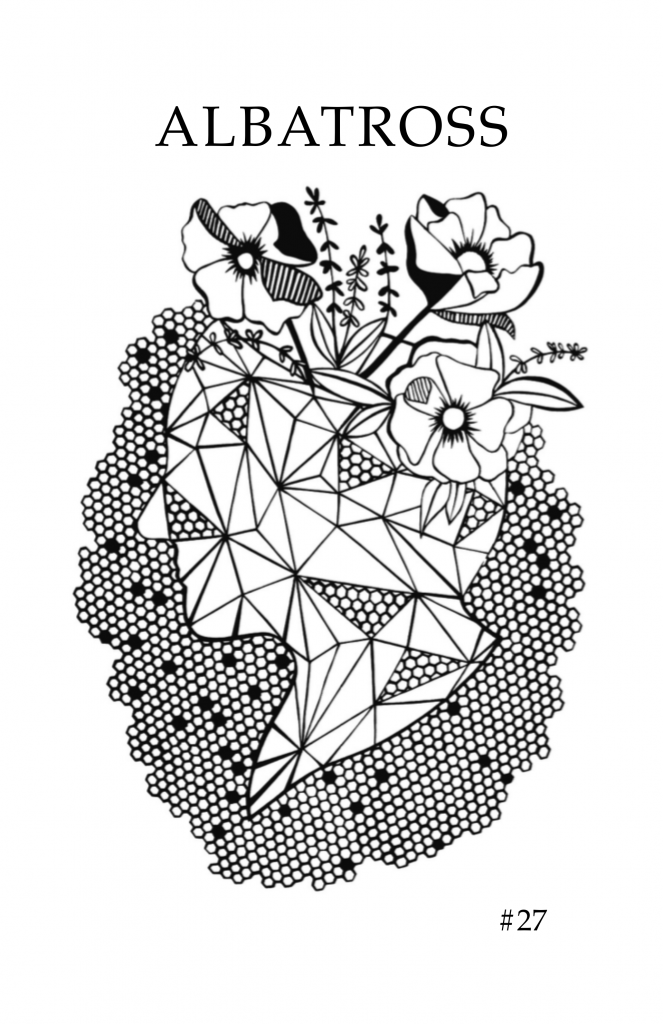
Featured image: “Amber Matter,” by Portia Apple.
in Albatross issue #27, 2017
From The MÉLANGE
Occasional Journal of Poetry
A little less than a decade ago, I attended a Buddhist event in Haverhill, MA. It involved a few nights sleeping on the temple floor, in the same room as the main altar, then waking up to get hands-on training in performing some small number of ceremonies: what to chant and when, where to play which drum, when to strike each bell, and what to do with one’s hands when not engaged in any of the above.
Getting to Massachusetts was no problem. I took a budget bus line from the east side of Midtown Manhattan, just north of the United Nations Headquarters, into Boston. But then there was the matter of the trip from Boston to Haverhill.
I had neither a car nor the monetary means to procure one by hire, but a member of the Haverhill Temple had reached out to me, we were in contact by text message, and he would be picking me up in his car at the bus station in Boston to take me to the retreat. His name was Richard Smyth.
During the roughly hour-long drive, we first exchanged small talk, then began to probe, politely, one another’s histories. This is when we discovered that he had, for many years (decades, in fact!), edited a poetry journal whose back issues I had perused in the 1990s at the Willis Library on the campus of the University of North Texas where, in those years, I was earning my Bachelor of Arts in English Composition. Concentration: Poetry.
![[Entrance to A. M. Willis Library from south 5], photograph, 1996~; (https://digital.library.unt.edu/ark:/67531/metadc850964/: accessed September 22, 2023), University of North Texas Libraries, UNT Digital Library, https://digital.library.unt.edu; crediting UNT Libraries Special Collections.](https://melange.ink/wp-content/uploads/2023/09/metadc850964_xl_UNTA_U0458-001-222_01-701x1024.jpg)
This photo was taken c. 1996, which means there’s at least a vanishingly small chance that your author is among the tiny people milling about in that archway.
Willis Library is an austerely boxy brutalist cuboid mass of brick in the center, roughly, of the U.N.T. campus, and it was something of a quiet refuge for me those first few semesters at my alma mater. My poetry mentor, Regents Professor Emeritus Dr. Bruce Bond, PhD, had encouraged me to spend some time reading through the literary journals stocked in the musty interior of that blockish chamber of archives, and at least a handful of Smyth’s Albatross issues were there for me to thumb through as I figured out what it meant to want to write poems.
Back in the twenty-first century on a car ride in Massachusetts, I related to Smyth that I’d read Albatross nearly two decades earlier, and together we marveled aloud regarding the diminutive nature of the ever-shrinking universe we inhabit.
Once my long weekend at the Buddhist temple concluded, Smyth and his wife repeated the favor, albeit in reverse, and drove me back to the bus station. That was 2014. We stayed in touch over the years — he was even an overnight guest at my Bedford Stuyvesant apartment once while in town for a film event featuring his sons (talented filmmakers, both of them).
I often self-effacingly refer to my Bachelor of Arts as my “Degree in Poetry,” usually with a tongue-in-cheek quip about how it perfectly prepared me to, say, spend eleven years behind bars. As a bartender, I should probably clarify. But there’s more than a little truth to this.
Toward the end of my final year, my mentor, the aforementioned Dr. Bond, invited me to lunch on Fry St one day. He encouraged me to attend graduate school at U.N.T., specifically in the Creative Writing department, and more specifically working in poetry. And believe me: I was tempted! Dr. Bond was an inspiration to work with, and I won’t lie that it was nice to occasionally pick up a copy of the Paris Review and see my mentor’s byline over a poem or two.
But there was a problem. A pretty big problem, in fact, and that was my poetry. What I was writing.
I wasn’t happy with it.
The life a poet lives is as important to their work as the craft they hone.
My writing teachers at U.N.T. — Dr. Bond, Dr. Austin Hummel, and Dr. Lee Martin — had instilled in me a fair amount of discipline in the craft and musicality of the English language. I somehow manifested in myself a hunger to read as much poetry as I could get my hands on, whether I liked it or not, and a compulsion to go back over every single line to perform a rather thorough scansion of its rhythm, making note of the number and metrical classification of each of its feet. Then I began to do the same with prose, and was delighted that, once unlocked, words everywhere have music just tumbling out of them — prose, pulp and literary fiction, the marketing copy on the backs of cereal boxes. Everywhere. I learned to pay attention to consonance and assonance and the beautiful intersection each of them can sometimes make with dissonance. It was around this time that — despite my adventures in developing a crush on the professor of my Intensive French course, with whom I spent sixteen long (but never long enough for my blushing heart!) hours a week — I decided that the English language is a fantastically plumaged rara avis which any poet worth the ink they spill should be damn well grateful to claim as their lingua materna.
I knew how to make a few words sing on a page, is the point I’m getting at, but I also knew my limitations. I knew what I was writing wasn’t what I wanted to see in print anywhere — even if anyone had wanted to publish it, which I was in no way certain of.
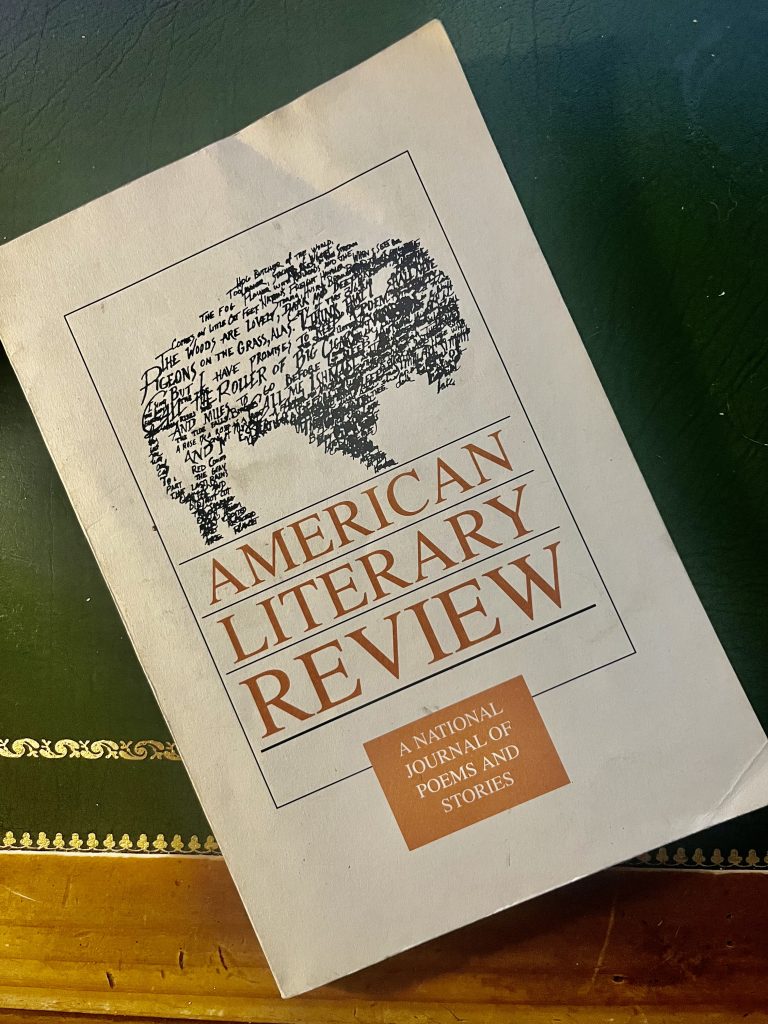
Except for Dr. Bond, I should add. He said he’d gladly run my poems in the American Literary Review, the U.N.T. Department of English’s own literary journal, if students and alumni of the school hadn’t been expressly barred from consideration at the time.
But I was twenty-two years old, and had not yet faced any brutal failures, fallen into bottomless wells of hopelessness, forded the icy waters of a crisis of faith, nor lost any friends or lovers to the cold shocking fingers of death’s grasp. I grasped the craft of forming pretty words, yet had little to write about.
John Fante famously told young writers to “live life in the raw, to grapple with it bravely, to attack it with naked fists.” The life a poet lives is as important to their work as the craft they hone. I’m not sure that’s exactly what I was thinking as I declined Dr. Bond’s invitation to enter the graduate program, but I distinctly remember that I was in workshops and classes with MFA students, and I knew unequivocally that I didn’t like what they were writing. It seemed to me there was a danger in ensconcing myself in the halls of academia, and, however risk-amenable I soon proved to be, this was a danger I wanted no chance of encountering. So I instead started a band, and moved with that band to New York City with $600 cash in my back pocket, a couch to sleep on and a job interview for a role as a phone operator. I landed the job, where I earned eight-dollars-and-change per hour in an Upper East Side call center fielding, among other things, after-hours 311 callers and overflow customers for New York City’s Health + Hospitals agency. I wasn’t there long; I quickly left to start what would become a decade career as a bartender.
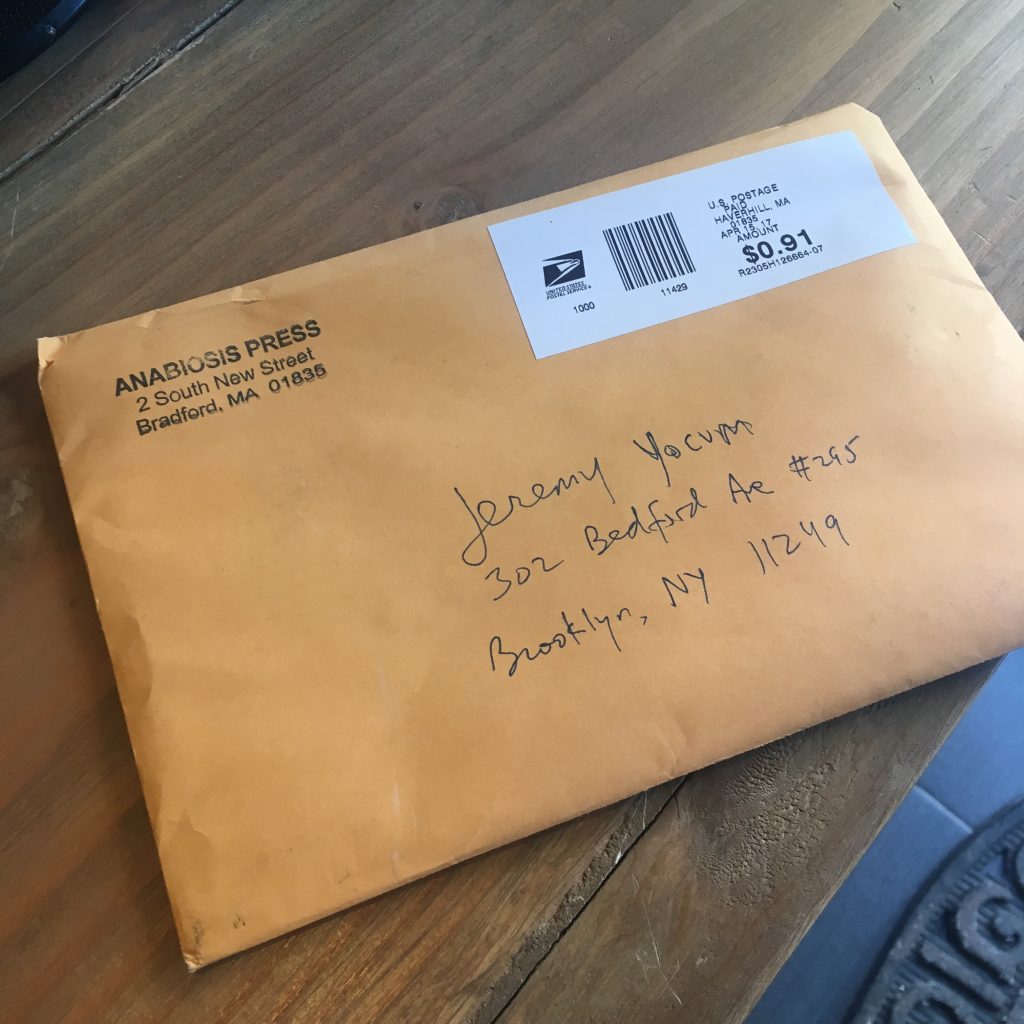
(Note: This is no longer my address.)
That next decade afforded me, in spades, all the adventures, misadventures, pain, ecstatic joy and wild stories I could have dreamed of — including the theft of a laptop on which I’d kept about four years of poetry, among them a cycle of ten poems I’d called Hosannas. Nothing remained from those years beyond a handwritten draft of one poem and the three or four works I had, through intense stages of rewriting, memorized. (For this reason I’ve come to think of Dino Campana, with his loss of the original manuscript of Canti Orfici, as a kindred spirit from an imagined former life.) All this time I wrote, often in the wee hours of the morning while walking home drunk after working a shift at some bar or another.
And so it came to be that, around 2015, I had a batch of poems I felt I would finally be happy to see in print. I remembered my car ride in Haverhill with Smyth and his wife, and I thought, “Who better to seek first publishing with than a fellow Buddhist, one whose periodical played a role in my very earliest days as a poet?
I sent him an email, and he said he welcomed the opportunity to review a submission from me. I dutifully printed everything according to his publication’s guidelines for manuscripts, folded the pages carefully into an envelope, addressed it and stamped it, then dropped it in the mailbox closest to my apartment with no small sense of having done something momentous.
Then in 2017, the below three poems appeared in Albatross, issue #27:
Little Song #3
Mourning. Choked and cloaked
as a hung monk. Sky-buried.
Wings a heart-splayed
rain of answered prayers,
folklored antlers, sick-green, rare as
the small alabaster spine
of a four-foot dragon
coiled under glass
in a cloud of formaldehyde.
Emmylou
Who will remember your name?
These breeze-combed
trees with their
thousand hushes.
Under the thunder
on the tall white porch,
a mislaid teacup catches rain.
Name me one thing more
beautiful than a living
being’s laughter.
Since Your Birthday
I paid attention, recorded
everything: red
big moonrise, quick over cloudbank.
The sourmilk scent: mums wilt
on my altar, flesh ashing,
cymbals. All of us clanging: “Wrong,
wrong, wrong.” The fruit
offering baked into an ache.
A beautiful bright
house of slight
blue to walk through,
its name “Tomorrow
and the Big
Sky Who opens
Up With It.” Sliver
of lapis in my changepocket.
My thumbnail hill-lost,
wandering your clavicle.
My heart’s throat
and the song you pull
from it. Your lilypetal
fingers bloom
onto my palm.
Thrum of thumbed string,
secret as a tree root drinks rain.
There is no lack of you.
And how you found your way at the bottom of this page. If you weathered this whole storm of words, or even just skipped straight to the poems, I feel I must — as every poet should do when a friend or acquaintance has suffered to read the interminable ramblings of our epodic output — thank you.
Thank you for reading.
Sincerely,
Jeremy Yocum
The MÉLANGE Occasional Journal of Poetry
